
Customer and use case
Specify the eligible UAE-based or internationally active customer segment and the financial job the product must complete.
Connect payment providers and rails through one integration layer with configurable routing, clear fallback logic, unified transaction states and reconciliation-ready data. For a UAE launch, customer eligibility, provider coverage and operational responsibilities are confirmed for the specific use case before implementation.
Payment orchestration workflow
AED 24,000 · business payment · provider-independent state
Primary
Provider A
Eligible
Fallback
Provider B
Ready
Alternative
Rail C
Rule-based
UAE market context
Confirm the eligible payment methods, currencies, providers, regulated responsibilities and operational ownership for the first orchestration workflow.
Specify the eligible UAE-based or internationally active customer segment and the financial job the product must complete.
Confirm which entities provide regulated services and who owns onboarding, controls, exceptions, support and reconciliation.
Begin with a coherent product, corridor or client segment and expand from measured customer and operational outcomes.
Framnex provides technology infrastructure, not legal advice or regulatory authorisation. Availability depends on the selected product, providers, customers and jurisdictions.
Commercial model
A payment orchestration platform gives each instruction a canonical identity and state, then coordinates provider selection, execution, fallback, status and reconciliation without making the customer journey provider-specific.
Where it fits
Add or change payment providers while preserving one API contract and customer payment experience.
Where it fits
Coordinate existing and new payment capabilities behind a consistent product and operational layer.
Where it fits
Connect collections, transfers and payouts to clear states and operational ownership across participant workflows.
Orchestration workflow
The routing decision should use product and provider facts while preserving one internal payment record from initiation through settlement.
Instruction
Give the payment one identity, amount, currency, customer context and intended outcome before selecting a provider.
Eligibility
Evaluate geography, currency, payment method, provider capability and configured commercial or risk constraints.
Execution
Send the instruction with explicit idempotency, timeout, retry and failure boundaries.
Outcome
Translate provider responses into consistent status, exception and reconciliation records.
Routing rules should reflect verified provider capabilities and contracts. Framnex does not present unsupported providers or payment methods as universally available.
Capabilities
Choose the components that solve the immediate customer need, with the option to connect more services as the product grows.
Connect selected gateways, processors, banks and payment rails through stable product-facing interfaces.
Apply explicit eligibility, routing and fallback rules without rebuilding the customer-facing payment flow.
Translate provider-specific responses into consistent pending, completed, failed and review states.
Keep payment references, provider events, fees and settlement context traceable for investigation and matching.
Operational control
A useful orchestration layer keeps product decisions, provider events and financial records connected so changes remain observable and reversible at the configuration level.
Configure
Represent provider priority, eligibility and fallback as explicit product configuration.
Observe
Retain the instruction, route, response and resulting internal state for support and performance review.
Reconcile
Connect provider references, fees and settlement outcomes to the ledger and reconciliation workflow.
Payment operations
Route payments through selected providers while preserving consistent status, fallback and reconciliation context for product and operations teams.
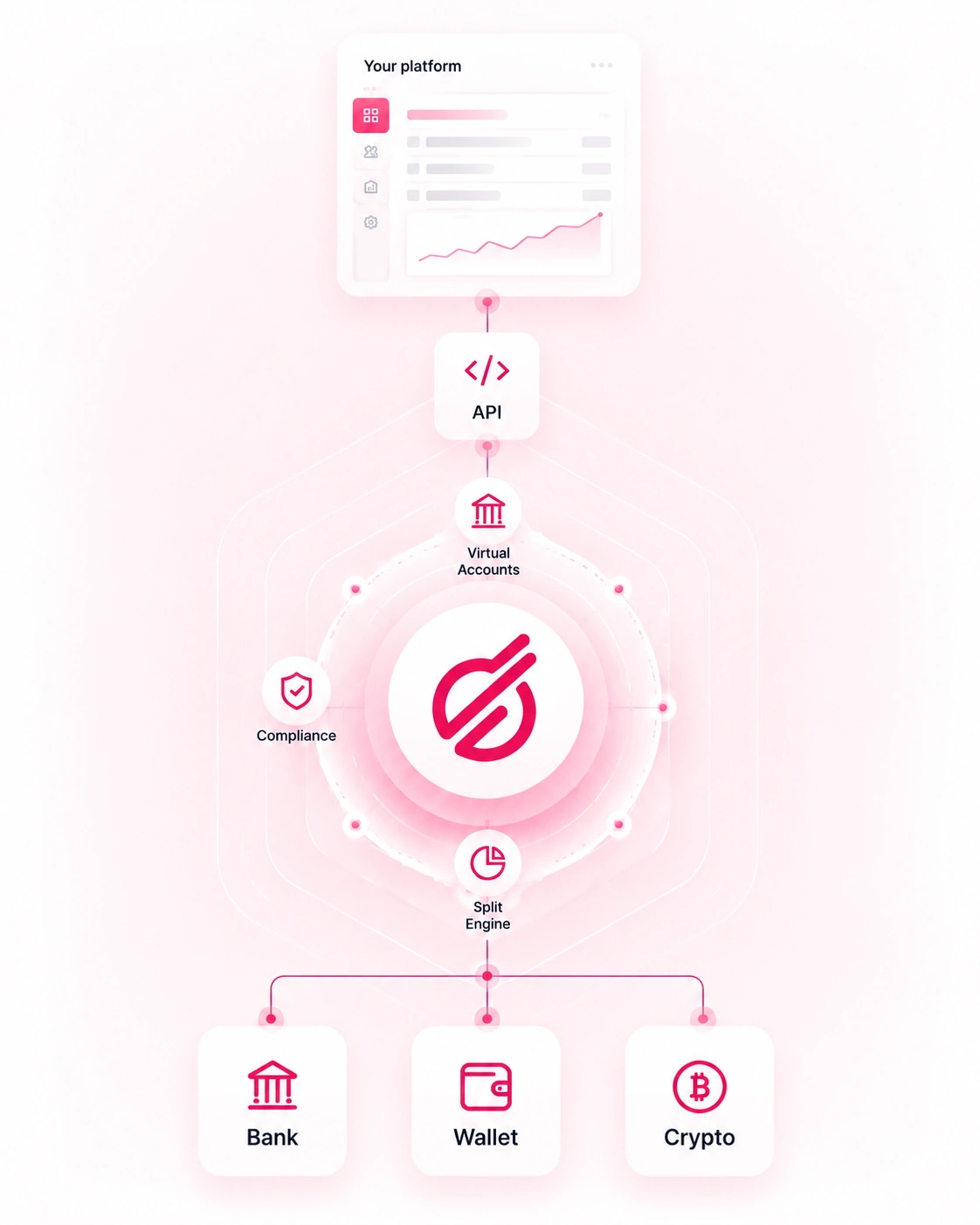
Launch path
A focused launch makes it easier to align commercial owners, operations and product teams before adding more complexity.
Payment orchestration FAQ
The commercial and operational questions teams most often ask before outlining their first launch.
A payment orchestration platform connects a product to multiple payment providers and services through one layer. It coordinates provider eligibility, routing, fallback, transaction states and operational data without forcing the customer experience to follow each provider’s implementation.
No. It coordinates the providers and rails selected for the product. Existing provider contracts and integrations can remain where they support the target architecture and operating model.
Yes. Routing can use verified provider capabilities and configured rules such as geography, currency, payment method, customer context and fallback policy. The available choices depend on the connected providers and commercial setup.
Failure handling is designed around explicit provider responses, idempotency and retry boundaries. Eligible fallback routes can be applied without creating duplicate payment instructions or losing the original transaction history.
The orchestration layer keeps provider references, attempts, statuses, fees and settlement context connected to the internal payment record so they can feed reconciliation and exception workflows.
Start with a discovery call
In a 15-minute discovery session, we'll discuss your business model, customer needs and commercial objectives to determine the right foundation for your financial offering.