
This guide explains how a cross-border payment platform works, what affects its cost and performance, and what businesses should consider when choosing one.
What Is a Cross-Border Payment Platform?
A cross-border payment platform is a system that enables businesses to send, receive, and manage payments between different countries and currencies. It connects the processes required to move funds from a payer in one market to a recipient in another, including payment routing, currency conversion, compliance checks, and settlement.
Businesses use cross-border payment platforms for a range of international payment flows. These can include paying overseas suppliers and contractors, receiving payments from customers in other markets, managing marketplace payouts, and moving funds between business entities.
The platforms are particularly relevant to businesses with frequent or complex international payment requirements, including fintech companies, payment providers, marketplaces, FX businesses, SaaS platforms, and companies serving international clients.
Capabilities vary between providers, but commonly include multi-currency payments, foreign exchange (FX), access to international and local payment rails, transaction tracking, settlement, and reconciliation. Some platforms also provide APIs, compliance tools, and infrastructure for embedding cross-border payment capabilities into other products.
How Do Cross-Border Payment Platforms Work?
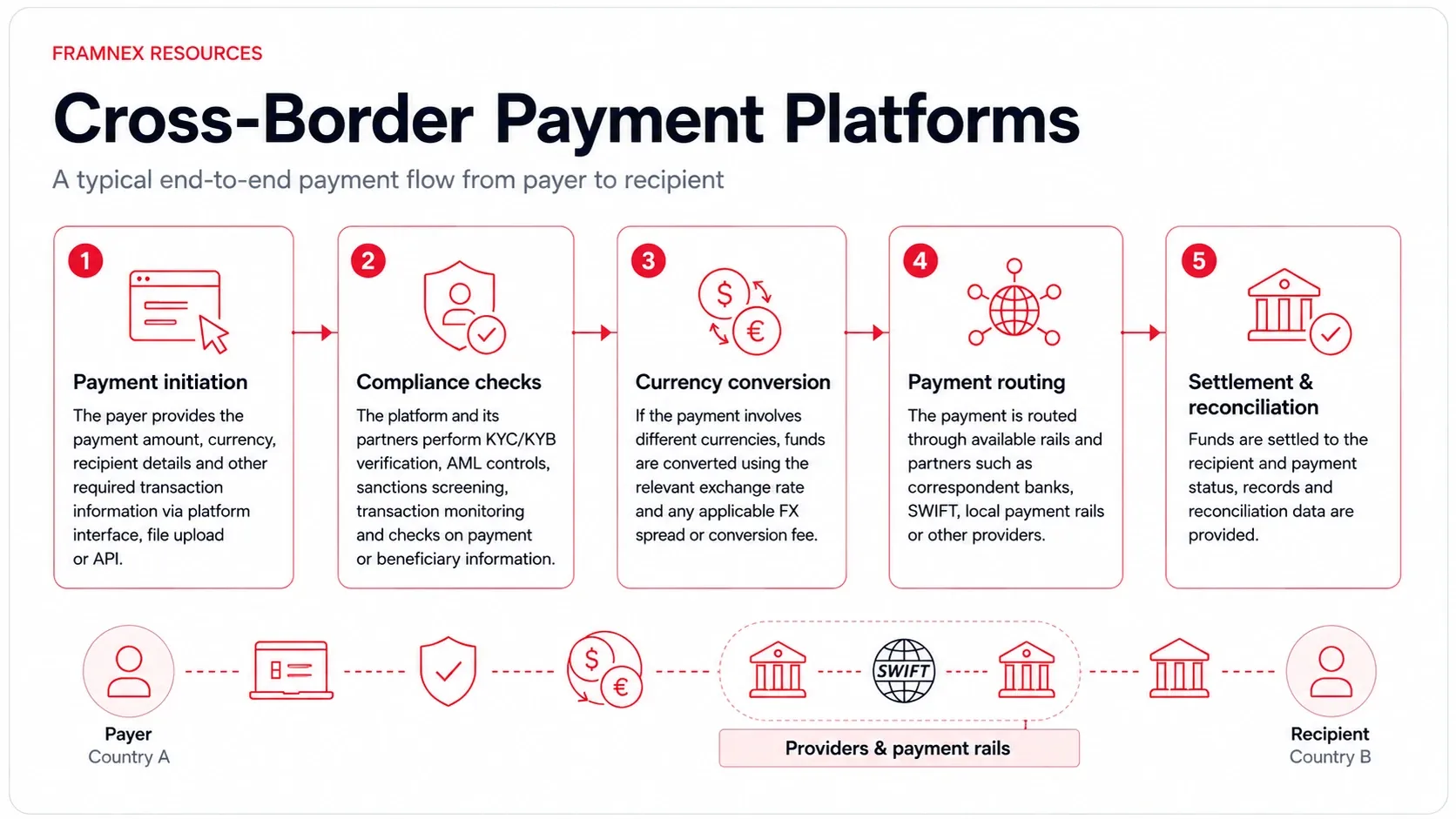
Cross-border payment platforms coordinate several processes to move funds from a payer in one country to a recipient in another. The steps below represent a typical payment flow, although the exact sequence can vary depending on the currencies, payment corridor, available payment rails, providers, and regulatory requirements.
1. Payment Initiation
The process starts when the payer provides the payment amount, currency, recipient details, and other required transaction information. Payments may be initiated through a platform interface, uploaded in bulk, or submitted through an API.
2. Compliance Checks
Before a payment is processed, the platform and its financial partners may perform required compliance checks. These can include KYC or KYB verification, AML controls, sanctions screening, transaction monitoring, and checks on payment or beneficiary information.
3. Currency Conversion
If the payment involves different currencies, funds may need to be converted before reaching the recipient. The platform applies the relevant exchange rate and any associated FX spread or conversion fee, depending on the provider and payment setup.
4. Payment Routing
The payment is then routed through the available financial infrastructure. Depending on the corridor, currency, and provider, this may involve correspondent banks, SWIFT messaging, local payment rails, or other banking and payment partners. The route can affect both the cost and the time required to complete the transaction.
5. Settlement and Reconciliation
Once the payment reaches the destination, funds are settled to the recipient according to the applicable payment method and banking arrangements. The platform can also provide payment status information, transaction records, and reconciliation data so businesses can track completed, pending, failed, or returned payments.
Traditional Cross-Border Payments vs Modern Payment Platforms
Factor | Traditional bank-based payments | Modern cross-border payment platforms |
Routing | Primarily correspondent banking | Multiple banking and payment rails |
FX | May involve intermediary conversion | FX integrated into the payment flow |
Integration | Bank portals and manual processes | APIs and automated workflows |
Visibility & reconciliation | More fragmented and manual | Centralised tracking and reporting |
Scalability | More operational overhead | Easier integration into higher-volume workflows |
Modern platforms do not eliminate the underlying banking infrastructure; instead, they can provide a single layer for accessing payment rails, managing FX, tracking transactions, and automating payment workflows. Actual capabilities, routes, and settlement times vary by provider and payment corridor.
What Do Cross-Border Payments Cost?
The cost of a cross-border payment can include several charges, depending on the currencies, payment corridor, provider, and route used. Looking only at the advertised transfer fee may therefore give an incomplete picture of the actual cost.
Transfer and Transaction Fees
Providers may charge a fixed fee, a percentage of the transaction amount, or a combination of both. Fees can also vary by currency, destination, payment method, and transaction volume.
FX Spreads and Conversion Costs
When a payment requires currency conversion, the exchange rate becomes part of the total cost. A provider may apply an FX spread or markup to a reference exchange rate, meaning the effective cost of conversion can be higher than the stated transaction fee.
Intermediary and Correspondent Bank Fees
Payments routed through correspondent banking networks may pass through one or more intermediary banks. These institutions can charge additional processing fees, which may be deducted from the transferred amount or charged separately.
Receiving and Payout Fees
Depending on the payment method and destination, the receiving bank or payout provider may also charge a fee. This can further reduce the amount ultimately credited to the recipient.
Total Cost and Final Amount Received
The most useful way to assess the cost of a cross-border payment is to consider all charges together: the transfer fee, FX costs, intermediary charges, and any receiving or payout fees. Businesses should also look at the final amount received by the beneficiary, as this reflects the practical cost of moving funds across borders more accurately than the advertised transfer fee alone.
How to Choose a Cross-Border Payment Platform
The right cross-border payment platform depends on where a business operates, which currencies it uses, how payments are integrated into its workflows, and what regulatory requirements apply. When comparing providers, focus on the capabilities that directly affect payment coverage, cost, reliability, compliance, and scalability.
Country and Currency Coverage
Start by checking whether the platform supports the countries, currencies, and payment corridors your business needs. Coverage should reflect both current operations and markets you may enter as the business grows.
It is also important to review available payout options. A platform may support international transfers, local payment rails, or a combination of both, with availability varying by market and currency.
Total Payment Cost
Compare the total cost of moving funds rather than the headline transaction fee. This includes the platform’s pricing structure, FX spreads or conversion charges, and any fees that may be applied by intermediary banks or other third parties.
Pricing transparency is particularly important for businesses processing payments at scale. Providers should make it possible to understand the total amount charged to the sender, applicable fees and exchange rates, and the amount ultimately received by the beneficiary.
Speed and Reliability
Settlement times can vary significantly by corridor, currency, payment rail, and provider. Compare expected processing and settlement times for the routes that matter to your business rather than relying on a single general estimate.
The platform should also provide clear payment status information and a process for handling delayed, failed, or returned transactions. This becomes increasingly important as payment volumes grow and manual tracking becomes difficult.
Compliance and Security
Cross-border payments involve regulatory requirements across multiple jurisdictions. When evaluating a platform, consider its approach to KYC and KYB, AML/CFT controls, sanctions screening, and transaction monitoring.
Businesses should also assess whether the provider’s licensing and regulatory setup is appropriate for the markets and services they intend to use. Requirements vary by jurisdiction and by the type of payment or financial service being offered.
Integration and Scalability
For businesses that need to automate payment operations or integrate them into an existing product, assess the platform’s API capabilities, webhooks, bulk payment functionality, and reporting tools. Access to structured transaction and reconciliation data can reduce the operational work involved in managing higher payment volumes.
Scalability is not only about transaction volume. A suitable platform should also be able to support additional currencies, payment corridors, and markets as business requirements evolve, without requiring the entire payment infrastructure to be rebuilt.
Adding Cross-Border Payments to Your Product
There is a difference between using a cross-border payment platform for your own business transactions and offering payment capabilities as part of your product. A company paying international suppliers, for example, primarily needs access to suitable currencies, payment corridors, FX, and reliable settlement. A marketplace, fintech, or SaaS platform that wants customers to initiate or receive payments within its product needs a deeper level of integration.
Using APIs for Payment Integration
APIs can be suitable when a business already has its own product and wants to connect specific payment functions to it. Depending on the provider, APIs can support payment initiation, beneficiary management, FX, payment status updates, bulk transactions, and reconciliation without requiring teams to manage each transaction through a separate platform interface.
This approach gives businesses more control over payment workflows while allowing the underlying provider to handle the payment infrastructure.
When Embedded or White-Label Infrastructure Becomes Relevant
Embedded infrastructure becomes relevant when payments need to form part of the customer experience rather than remain an internal operational process. For example, a marketplace may want sellers to receive payouts within its platform, while a fintech or FX business may want customers to access transfers, currency conversion, or accounts without leaving its product.
White-label infrastructure goes further by allowing businesses to offer financial functionality under their own brand. Depending on the infrastructure provider and regulatory setup, this can include branded accounts, payments, FX, and related financial services.
The appropriate model therefore depends on what the business is trying to achieve: make international payments, automate payment operations, embed payments into an existing product, or offer a broader branded financial product.
Matching Cross-Border Payment Infrastructure to Business Needs
Business need | What to look for |
Make international business payments | Multi-currency payments, FX, transparent fees |
Automate payment operations | APIs, bulk payments, webhooks, reconciliation |
Offer payments to customers | Embedded payment infrastructure |
Launch a branded financial product | White-label infrastructure, accounts, payments, FX |
How Framnex Supports Cross-Border Payment Products
For businesses that want to integrate cross-border payments into their own products, Framnex provides modular financial infrastructure that brings payments, FX, accounts, and compliance capabilities into a single environment.
Businesses can use Framnex to support cross-border payment flows with multi-currency and FX functionality, including the ability to manage currency conversion as part of the payment journey. This can be relevant for fintechs, payment providers, marketplaces, FX businesses, and other platforms that need to move funds between markets or provide international payment capabilities to their customers.
Framnex also provides APIs and embedded infrastructure for integrating payment functionality into existing products and workflows. For businesses that want to offer financial services under their own brand, white-label infrastructure can support branded payment experiences, accounts, FX, and related financial functionality.
Compliance capabilities, including KYC/AML, transaction monitoring, security controls, and regulatory support, can be incorporated into these payment flows. Because the infrastructure is modular, businesses can start with the cross-border payment capabilities they need and add further financial functionality as their product and market coverage expand.
FAQ
Can Cross-Border Payments Be Made Without SWIFT?
Yes. SWIFT is widely used for international bank transfers, but it is not the only way to move money across borders. Depending on the currencies, countries, and provider, a cross-border payment platform may use local payment rails, regional networks, or banking partners to route a transaction without relying on SWIFT for the entire payment journey.
Why Do Cross-Border Payments Fail or Get Returned?
Cross-border payments can fail or be returned because of incorrect beneficiary details, compliance or sanctions checks, unsupported currencies or payment corridors, account restrictions, or issues involving intermediary banks. Requirements vary between countries and providers, so accurate payment information and clear transaction status tracking are important when managing international payments.
How Do Multi-Currency Accounts Help With Cross-Border Payments?
Multi-currency accounts allow businesses to hold, receive, and manage funds in more than one currency. This can reduce the need to convert currencies immediately when funds are received and give businesses more control over when FX conversion takes place. Available currencies, account details, and payment capabilities depend on the provider.
What Is Payment Orchestration in Cross-Border Payments?
Payment orchestration is the coordination of multiple payment providers, banking connections, or payment rails through a unified infrastructure. In cross-border payments, orchestration can help route transactions according to factors such as destination, currency, cost, availability, or payment method. It can also centralise payment status data and reduce the complexity of managing multiple integrations.
What Is a Cross-Border Payment Corridor?
A cross-border payment corridor is a pathway for moving funds between two countries or markets. For example, payments from the UAE to the UK form a UAE–UK payment corridor. Available payment rails, currencies, fees, settlement times, and regulatory requirements can differ between corridors.
Do Cross-Border Payments Always Require Currency Conversion?
No. Currency conversion is only required when funds need to move from one currency into another. If the sender and recipient transact in the same currency, FX conversion may not be necessary, although other cross-border payment fees can still apply. Multi-currency accounts can also give businesses more flexibility over when currencies are converted.
What Is the Difference Between Cross-Border and Domestic Payment Platforms?
Domestic payment platforms primarily support transactions within a single country or jurisdiction, while cross-border platforms support payments between different countries or jurisdictions. Cross-border transactions can involve additional requirements such as FX conversion, international payment routing, intermediary institutions, and compliance checks across multiple jurisdictions.